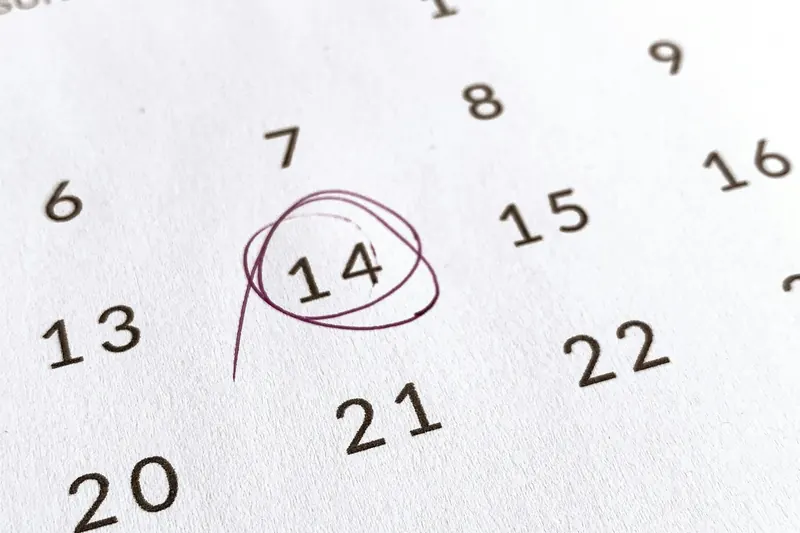
Two different dates
The LMP is the first day of the last menstrual period before pregnancy, and it is used to estimate the date of delivery.1 Conception happens later: an ovary releases an egg at ovulation,3 and fertilization, the union of an egg and a sperm, takes place in the fallopian tube.1
| Compared | LMP | Conception |
|---|---|---|
| What it is | The first day of the last period | When an egg is fertilized |
| How it is known | From your own note of when bleeding started | Not directly: it is estimated from other dates |
| Used for | Counting pregnancy weeks and estimating the due date | Describing how the embryo develops |
| On the convention | Day 0 | About day 14 |
Because dating starts at the LMP, pregnancy is assumed to start 2 weeks after it.1 The 2 weeks come from the standard assumption of a 28-day cycle with ovulation on day 14.4
How the dates line up on the calendar
On the convention, one LMP date gives three dates in a fixed pattern: conception 14 days after the LMP, and the due date 280 days after it,4 which is 266 days after the estimated conception date.
Worked example
First day of the LMP: August 1, 2026
Estimated conception (+14 days): August 15, 2026
Estimated due date (+280 days from the LMP): May 8, 2027
Measured from ovulation rather than the LMP, a study that timed ovulation with hormone tests found a median of 268 days (38 weeks, 2 days) to birth, 12 days less than the 280-day count from the LMP.5
Why the gap is not always two weeks
Ovulation typically happens about 14 days before the next period starts, so its timing depends on the length of the cycle. ACOG gives examples: in a 21-day cycle, ovulation is likely around day 7; in a 35-day cycle, around day 21.3
Even in regular cycles, timing varies. In a study of 221 women and 696 cycles, the fertile window fell on a broad range of days: only about 30% of women had it entirely within days 10 to 17, most reached it earlier and some much later, and its timing could be highly unpredictable even when cycles were usually regular.2
The study that timed ovulation found that pregnancy length varied more when it was measured from the LMP than from ovulation, which reflects this variability.5 Irregular periods and your due date covers what this means when cycles change from month to month.
Why the day of conception is rarely known
The fertile window is about 6 days each cycle. Sperm can live in the body for up to 5 days, and an egg survives for about 12 to 24 hours after ovulation, so pregnancy can follow sex from up to 5 days before ovulation to 1 day after.3 The day of sex and the day of conception are therefore not necessarily the same.
Late ovulation cannot be predicted either: some women in the study above were still potentially fertile in the fifth week of their cycle.2
What these dates cannot tell you
An LMP date, or a conception date estimated from it, cannot establish the exact day conception happened, and it cannot establish paternity. The estimate rests on an average cycle, while the timing of ovulation varies between people and from cycle to cycle.
Questions about timing or paternity
Dates worked out from a period, a due date or a calculator cannot answer these questions. A healthcare professional can explain what can and cannot be known in your situation.
See the conventional conception date
Enter the first day of your last period and the Conception Date Calculator adds the standard 14 days.
Common questions
How many days after my period did I conceive?
The convention assumes 14 days after the first day of the LMP.4 In real cycles ovulation often comes earlier or later than that, even when cycles are regular.2
Is the conception date the day we had sex?
Not necessarily. Sperm can live for up to 5 days, so conception can happen several days after sex.3
Can a conception date show who the father is?
No. A date estimated from a period or a due date cannot establish paternity.
Why is a pregnancy "2 weeks along" at conception?
Because the count starts at the LMP, about 2 weeks before conception is assumed to happen.1 How pregnancy weeks are counted explains the convention.
Sources
- American College of Obstetricians and Gynecologists (ACOG). How Your Fetus Grows During Pregnancy. patient FAQ, reviewed 2026.
- BMJ. Wilcox AJ, Dunson D, Baird DD. The timing of the "fertile window" in the menstrual cycle: day specific estimates from a prospective study. 321(7271):1259–62. 2000.
- American College of Obstetricians and Gynecologists (ACOG). Trying to Get Pregnant? Here's When to Have Sex. reviewed 2025.
- American College of Obstetricians and Gynecologists (ACOG). Methods for Estimating the Due Date (Committee Opinion No. 700). 2017; reaffirmed 2025.
- Human Reproduction. Jukic AM, Baird DD, Weinberg CR, et al. Length of human pregnancy and contributors to its natural variation. 28(10):2848–55. 2013.